
How to Release Trapped Emotions (Emotion Code Basics)
Once you’ve read about trapped emotions, the next question is usually:
how do you actually release them?
Not in theory.
Not just “feel your feelings” or journal about them.
But how it’s actually done in a real process.
This post will give you the basics as to how the process is done.
A Quick Note Before We Start
Trapped emotions aren’t stored in your conscious mind.
They’re stored in the body and subconscious.
Which means:
you can’t always think your way to them
you don’t need to relive painful past experiences to release them
If you want a deeper explanation of this, you can read more about trapped emotions here.
What Is the Emotion Code?
The Emotion Code is a method that works directly with the subconscious mind and body.
Instead of:
guessing
analysing
talking through everything
It allows the body to tell us exactly what needs to be released.
This is why the process is:
simple
precise
often much faster than traditional approaches
How Trapped Emotions Are Released (Step-by-Step)
Step 1 - Set Your Intention (Prayer)
Before anything else, one of the most important parts of The Emotion Code is taking a moment of silence.
This is a quick pause (usually 10–30 seconds) to:
ask for guidance
set your intention for the session (for me, this is where I connect to the person I’m working with)
come into a state of gratitude
It’s a simple step, but it’s foundational.
Your intention is what helps guide the subconscious during the session.
You might say a short prayer, or simply think something such as what I use:
“Thank you for guiding me and allowing me to help [this person/myself].”
The exact wording isn’t important - it’s the intention behind it.
This moment of slowing down and becoming present also calms the nervous system, creating a safe space for the subconscious to respond clearly.
Step 2 - Identify The Emotion
Once you’ve set your intention, you’re ready to begin identifying the first emotion ready for release.
Again, intention matters here.
You might ask:
“Do I have a trapped emotion that can be released right now?”
Or, if you’re working on something specific:
“Do I have a trapped emotion contributing to [symptom] that can be released right now?”
The exact wording isn’t critical - it’s the intention behind the question.
From here, you’ll use a muscle testing method of your choice to identify the emotion. If you’re new to this, you can learn more in this free course.
Muscle testing is both a skill and an art, and it can take time to develop. so be patient with yourself.
Once you receive a “yes” response, you’ll use the Emotion Code chart (pictured below) to identify the emotion.
This is done through a simple process of elimination:
Column A or B
Even or odd row
Then narrowing down to the exact row
Then confirming the specific emotion
Until you receive a clear “yes” from your subconscious on the specific emotion.
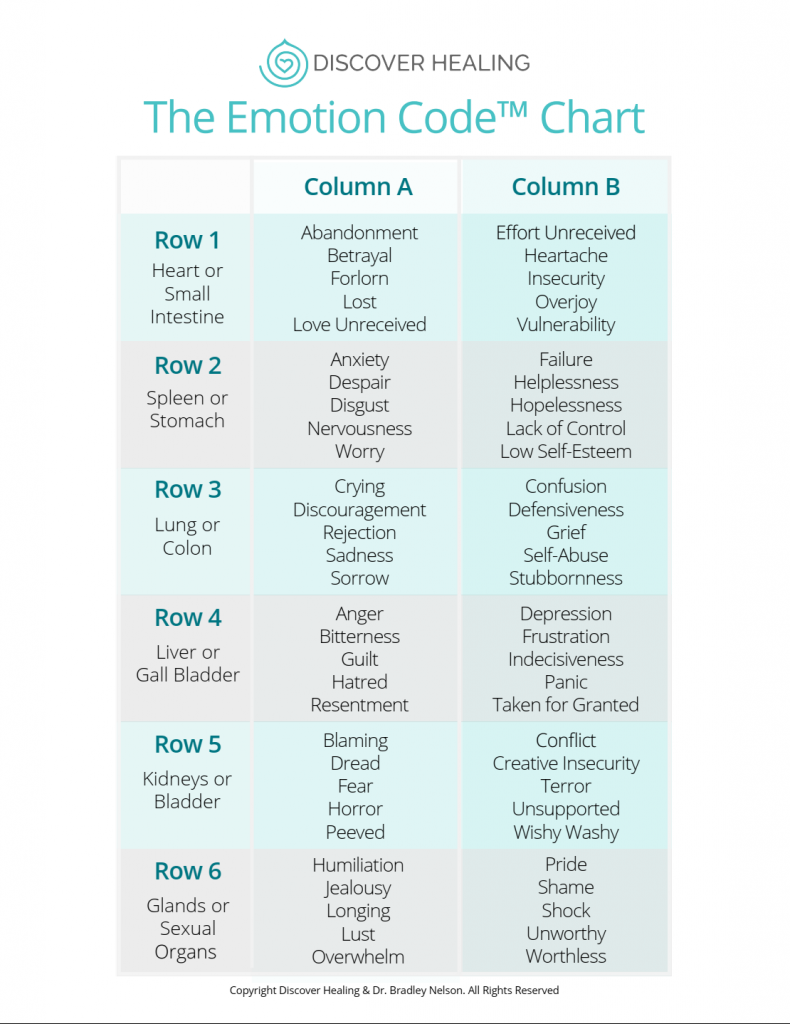
The Emotion Code Chart of emotions
Step 3 - Further Information
This step isn’t always needed, but it’s still necessary to ask.
Sometimes the subconscious will want to bring through extra context before the emotion is released.
You can ask:
“Do we need to know anything else about this emotion?”
Often, the only additional information is the age the emotion became trapped.
You can find this using a similar process of elimination - for example:
divide your age in half
ask if it occurred before that age
and continue narrowing it down until you reach the exact point in time.
Step 4 - Release The Emotion
Now for the release.
This is where the trapped emotion is cleared from the body and energy field.
The Emotion Code uses the Governing Meridian - the central energy pathway that runs from the forehead, over the head, and down the spine.
To release the emotion:
take a magnet (a simple fridge magnet works)
swipe from the forehead, over the head, to the neck
repeat this 3 times while holding the intention to release the emotion
And that’s it.
You may feel some lightness, or on some occasions a wave of emotion come over you as the emotion is released. Some people yawn or feel the need to move a little bit. In most cases, you won’t feel too much.
Continuing the Process
You can repeat this process to release additional emotions.
However, especially when starting out, it’s generally recommended not to release more than 5–10 emotions at a time.
If you would like to learn how to do the Emotion Code yourself more in depth and with support, I recommend checking out the introductory Immersion Path course.
A Quick Note
While this process is simple, doing it accurately and consistently can take practice.
If you are looking for faster results, I always recommend working with a practitioner (such as myself) as you are learning, this allows us to go deeper and work more precisely with what’s ready to be released.
If you’d like to book a session with me, you can find out more here.
Why The Emotion Code Works
Most methods are still trying to solve this at the level of the mind.
But that’s not where trapped emotions are stored.
So instead of analysing everything, or trying to “fix” it consciously, we go straight to where it’s actually being held.
That’s why things that have been sitting there for years can shift much faster than you’d expect.
Where the Body Code and Belief Code Come In
The Emotion Code is often where this starts.
But sometimes there’s more causing an issue than just trapped emotions.
The Body Code looks at other imbalances in the body that might be contributing to certain issues.
The Belief Code goes even deeper, working with subconscious belief systems - the patterns running in the background that shape how you think, feel, and act.
You don’t need to figure out which one you need.
Your body does that for you, and that is why in my sessions, I utilise all three.
Wrapping Up
If you’ve been trying to release emotions on your own and feel like something still isn’t shifting, it’s usually not because you’re doing anything wrong.
It’s because what’s stored in the body isn’t always accessible consciously.
That’s where this work becomes powerful.
When the subconscious is guiding the process, things don’t need to feel forced - they simply begin to release.
And while doing this on your own is incredibly valuable (and something I highly recommend), if you’re looking for faster, more accurate results, working with a practitioner allows you to:
bypass blind spots and biases (we all have these)
go deeper
get to the root more efficiently
This is exactly what I help you do in sessions.
If you’d like to understand how this works in practice,
you can learn more about working with a Body Code practitioner online.
If you’re ready to clear things efficiently and start shifting this at the root,
you can book your session here.